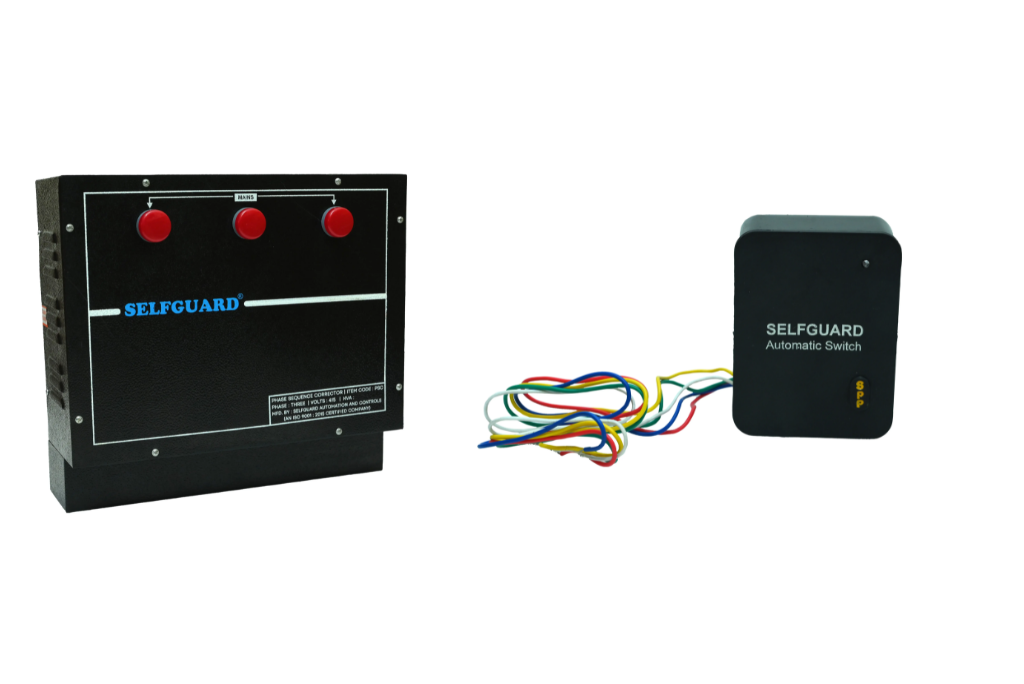
In a three-phase electrical system, maintaining a stable and correctly sequenced power supply is essential for the safe and reliable operation of motors, pumps, lifts, air conditioners, UPS systems, and other industrial equipment.
At Selfguard Automation and Controls, we design phase protection and automation solutions to help safeguard electrical equipment against common phase-related problems. Two conditions that are particularly important to understand are phase failure and phase imbalance.
Our Single Phase Preventer (SPP) and Automatic Phase Sequence Corrector (PSC) address these conditions in different ways. Understanding the difference between phase failure and phase imbalance also helps in selecting the right protection solution for an application.
What Is Phase Failure?
Phase failure occurs when one of the three phases in a three-phase electrical supply is lost or becomes unavailable. This can happen because of a blown fuse, loose connection, wiring problems, or a failure in the incoming power supply.
When one phase is lost while a three-phase motor is operating, the motor can experience a single-phasing condition. This can result in excessive current in the remaining phases, overheating, and potential damage to the motor windings if the condition is not detected and addressed.
Our Single Phase Preventer (SPP) is designed to protect motors against:
- Single phasing
- Reverse phasing
- Imbalanced voltage conditions
The SPP also provides separate indications for Missing Phase, Reverse Phase, and the presence of all three phases in the correct sequence.
What Is Phase Imbalance?
Phase imbalance is different from a complete phase failure. In an imbalanced three-phase system, the voltage across the phases is not equal or sufficiently balanced.
Even when all three phases are present, unequal voltage conditions can affect motor performance. Voltage imbalance can lead to unequal currents in the motor windings, increased heating, reduced efficiency, and additional stress on the motor.
Our Single Phase Preventer is designed to provide protection against imbalanced voltage, in addition to single phasing and reverse phasing.
Our Automatic Phase Sequence Corrector (PSC) also provides protection against imbalanced voltage and incorporates an inbuilt Single Phase Preventer.
Phase Failure vs Phase Imbalance
The difference can be understood through the conditions our products are designed to detect and protect against:
|
Condition |
What it means |
Relevant Selfguard protection |
|
Phase failure / missing phase |
One of the three phases is unavailable |
Single Phase Preventer |
|
Phase imbalance |
The three-phase voltage supply is imbalanced |
Single Phase Preventer and Automatic Phase Sequence Corrector |
|
Reverse phase |
The phases are not in the required sequence |
Single Phase Preventer and Automatic Phase Sequence Corrector |
It is important not to use phase failure and phase imbalance as interchangeable terms. A missing phase represents a loss of one phase, whereas phase imbalance refers to an unequal or imbalanced voltage condition.
Our SPP specifically identifies Missing Phase, Reverse Phase, and Imbalance Voltage as protection-related conditions.
Our Single Phase Preventer: Protection Against Phase-Related Problems
At Selfguard, we developed the Single Phase Preventer (SPP) to provide reliable protection for motors against several common three-phase supply problems.
The SPP protects against:
- Single phasing
- Reverse phasing
- Imbalanced voltage
The unit incorporates microcontroller technology and includes inbuilt delay timers for three-phase sensing.
Its indicator system makes it easier to identify the condition of the incoming supply:
- When all three phases are available and in the correct sequence, the Green Indicator glows after the preset delay and the SPP starts working.
- When the phases are in the wrong sequence, the Red Indicator starts blinking.
- When any one of the three phases is missing, the Red Indicator glows.
With these functions, the SPP continuously monitors important phase conditions and helps protect connected motors from potentially damaging electrical faults.
Our Automatic Phase Sequence Corrector: Maintaining the Correct RYB Sequence
The Automatic Phase Sequence Corrector (PSC) has a different primary purpose.
The PSC is designed to automatically maintain the correct RYB phase sequence, regardless of the sequence received from the incoming three-phase supply.
This makes it particularly useful for equipment where the correct phase sequence is essential for proper operation.
The PSC is designed for three-phase mains supply and is suitable for applications such as:
- Three-phase lifts
- UPS systems
- Air conditioners
- Motors
- Pumps
- Industrial machinery
Along with automatic phase sequence correction, the PSC provides protection against imbalanced voltage and includes an inbuilt Single Phase Preventer.
Our PSC is available in ratings ranging from 15 KVA to 82.5 KVA, including models of:
- 15 KVA
- 25 KVA
- 40 KVA
- 62.5 KVA
- 82.5 KVA
How Our Two Products Differ
Although the SPP and PSC share some protection functions, their primary purposes are different.
Single Phase Preventer
Our Single Phase Preventer primarily focuses on motor protection. It protects against single phasing, reverse phasing, and imbalanced voltage conditions.
It also provides clear indications for missing phase, reverse phase, and correct phase sequence.
Automatic Phase Sequence Corrector
Our Automatic Phase Sequence Corrector primarily focuses on maintaining the correct RYB phase sequence.
It automatically corrects the incoming phase sequence and, at the same time, provides protection against imbalanced voltage and incorporates an inbuilt Single Phase Preventer.
In simple terms, the SPP is primarily a phase protection device, while the PSC combines automatic phase sequence correction with phase protection.
Why Phase Monitoring Is Important for Motors
Three-phase motors depend on a stable and properly balanced power supply for reliable operation.
A single-phasing condition can create an unbalanced stator current, which can cause excessive heating and may eventually lead to winding insulation failure. Similarly, voltage imbalance can increase motor stress and affect operating efficiency.
This is why we focus on monitoring important phase conditions such as:
- Missing phase
- Reverse phase
- Imbalanced voltage
- Incorrect phase sequence
Our phase protection products are designed to detect these conditions and help prevent them from causing unnecessary damage to connected equipment.
Where maintaining the correct phase sequence is also a requirement, our Automatic Phase Sequence Corrector provides an additional level of control by automatically maintaining the RYB sequence.
Which Selfguard Product Should You Choose?
The right product depends on your application's specific requirement.
If you primarily need motor protection against single phasing, reverse phasing, and imbalanced voltage, our Single Phase Preventer (SPP) is designed for these requirements.
If you need to maintain the correct RYB phase sequence automatically, while also receiving protection against imbalanced voltage and having an inbuilt Single Phase Preventer, our Automatic Phase Sequence Corrector (PSC) is designed for this purpose.
You can learn more about our Single Phase Preventer and Automatic Phase Sequence Corrector to understand their specifications and applications.
Final Thoughts
Phase failure and phase imbalance are related but different conditions in a three-phase electrical system.
Phase failure occurs when one phase is lost, resulting in a missing-phase or single-phasing condition. Phase imbalance, on the other hand, refers to an imbalanced voltage condition between the phases.
At Selfguard Automation and Controls, our Single Phase Preventer is designed to protect motors against single phasing, reverse phasing, and imbalanced voltage. Our Automatic Phase Sequence Corrector goes a step further by automatically maintaining the correct RYB phase sequence, while also providing imbalanced-voltage protection and an inbuilt Single Phase Preventer.
With our experience in manufacturing electrical and electronic products for mains, generator, and agricultural automation since 1990, we continue to develop solutions using microcontroller technology with a focus on quality, reliability, and customer requirements.