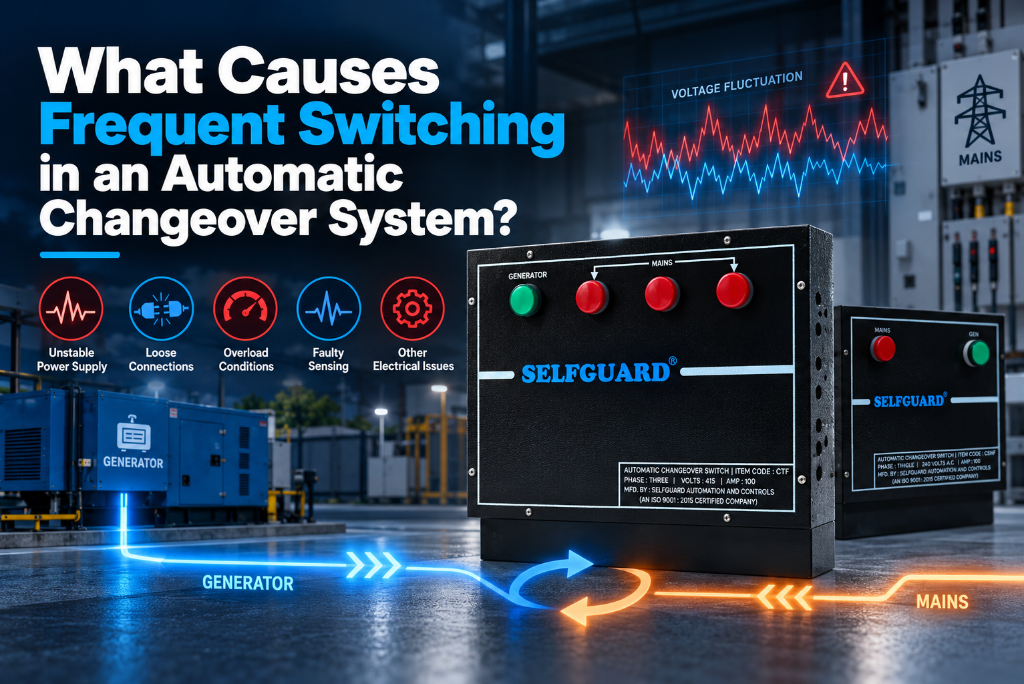
An uninterrupted power supply is important for residential, commercial, and other electrical installations. An Automatic Changeover Switch helps manage the transfer of electrical loads between mains and generator power. At Selfguard Automation and Controls, we offer automatic changeover switches designed to transfer loads automatically when the mains supply fails and switch back when the mains supply is restored.
Understanding how an automatic changeover system operates is important when examining frequent switching. Our single-phase and three-phase automatic changeover switches are designed for specific electrical supply arrangements and applications.
Understanding Automatic Changeover Operation
An automatic changeover switch transfers the connected load between the mains supply and a generator. When the mains supply fails, the load is transferred to the generator after it starts. When mains power returns, the load switches back to the mains supply, and the generator runs without a load.
This automatic transfer process is the fundamental operating principle of our automatic changeover switches. If switching occurs frequently, understanding this sequence provides the starting point for examining the system's operation.
The Role of Mains Supply Availability
The mains supply is an important part of the automatic changeover process. Our changeover switches are designed to respond to mains supply failure by transferring the load to the generator. When the mains supply returns, the load is transferred back.
Consequently, changes in mains supply availability are directly relevant to the switching process. However, our product specifications describe the normal operating sequence rather than identifying specific electrical conditions that cause repeated switching.
Generator Operation and Automatic Transfer
Generator operation is another part of the changeover sequence. When mains power is unavailable, the generator starts and the connected load is transferred to generator power. Once mains power returns, the load switches back to the mains supply.
Our automatic changeover switches are designed to manage this transfer automatically. Understanding the relationship between mains availability, generator operation, and load transfer helps explain how the system moves between its two power sources.
Choosing the Correct Automatic Changeover Switch
Selecting a suitable model and current rating is important when choosing an automatic changeover switch. We offer two product ranges for different electrical supply arrangements.
Our Single-Phase Automatic Changeover Switch (CSNF) is available in 40 A, 63 A, 100 A, 150 A, and 200 A ratings. It is designed for use between a single-phase mains supply and a single-phase generator.
Our Three-Phase Automatic Changeover Switch (CTF) is available in 63 A, 100 A, 150 A, and 200 A ratings. It is designed for a three-phase mains supply with a single-phase or three-phase generator. The specified application is for single-phase loads, including lights, fans, single-phase air conditioners, and motors.
Understanding these product specifications helps users identify the model that corresponds to their intended electrical installation.
Selfguard Automatic Changeover Switches
At Selfugard Automation and Controls, we use microcontroller technology in our automatic changeover switches. Our products are designed to transfer electrical loads between mains and generator supplies and return the load to mains when utility power is restored.
The CSNF and CTF models serve different supply configurations, making it important to review their specifications and intended applications before selecting a product.
Conclusion
Frequent switching in an automatic changeover system should be considered in the context of its normal operating sequence. Mains supply availability, generator operation, and the selected changeover switch's specifications are all relevant to understanding how automatic transfer works.