Modern buildings rely greatly on consistent and reliable power. Every vital activity, from three-phase motors and air-conditioning systems to lifts, lighting loads, and industrial gear, need a smooth and steady electrical supply. Any fluctuation, phase loss, or unexpected outage can result in equipment failure, downtime, or expensive repairs.
This is when an Automatic Transfer Switch (ATS), such as the one provided by Selfguard, comes in handy.
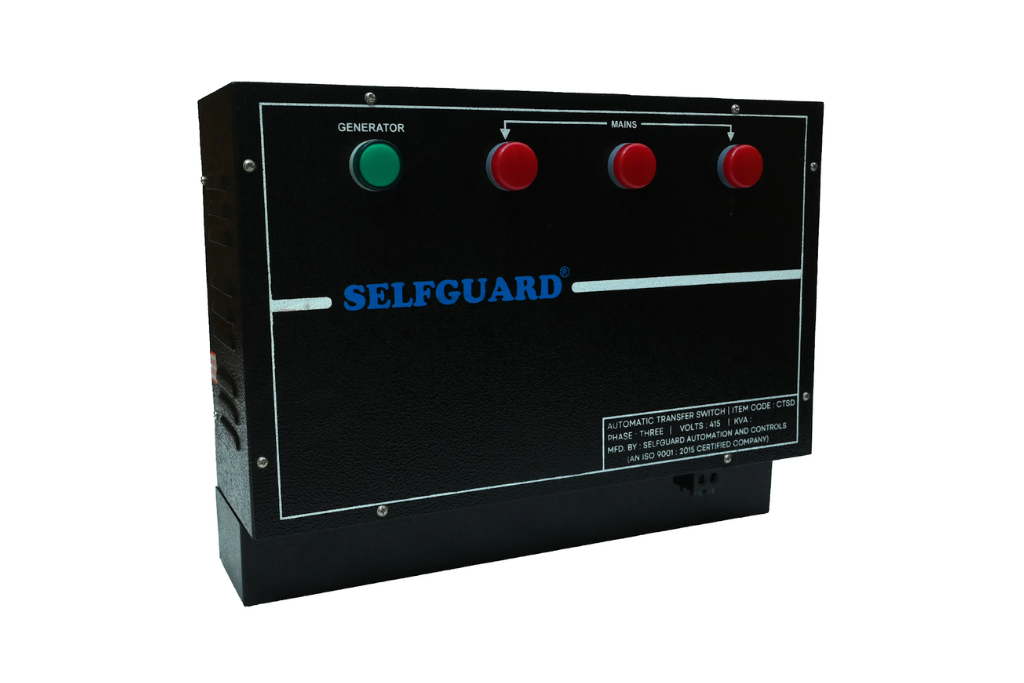
Selfguard's Automatic Transfer Switch - Three Phase (CTSD) is designed to provide a consistent power supply by automatically moving electrical loads between the main supply and the generator as needed. Its clever functioning mechanism and built-in precautions make it a dependable defence against power-related harm in modern commercial, industrial, and residential structures.
1. Continuous Monitoring of Power Sources Prevents Sudden Failures
The Selfguard ATS continuously checks the utility supply and the generator. When the mains electricity goes out or fails, the machine automatically switches the load to a generator.
By removing user intervention, it protects equipment from abrupt shutdowns, which are a typical source of damage in sensitive three-phase systems.
Similarly, after all three phases of the mains supply have returned and stabilised, the ATS automatically transfers the load back to the main source. This ensures that buildings always get power from the most reliable source at any given time.
2. Smooth Transition with Delay Timers Reduces Voltage Stress
The Selfguard ATS continuously checks the utility supply and the generator. When the mains electricity goes out or fails, the machine automatically switches the load to a generator.
By removing user intervention, it protects equipment from abrupt shutdowns, which are a typical source of damage in sensitive three-phase systems.
Similarly, after all three phases of the mains supply have returned and stabilised, the ATS automatically transfers the load back to the main source. This ensures that buildings always get power from the most reliable source at any given time.
3. Protects Three-Phase Loads from Phase Loss and Instability
Modern buildings use a wide range of three-phase loads, including:
- Motors
- Air-conditioning systems
- Industrial equipment
- Lifts
- Lighting circuits
The Selfguard ATS is specifically designed for three-phase mains and three-phase loads, making it ideal for such infrastructures.
By ensuring the load is transferred only when all three phases of the main supply return and stabilize, the ATS prevents the risk of:
- Phase imbalance
- Motor overheating
- Burnout of three-phase machinery
This stability is vital for the long life of high-value equipment and uninterrupted building operations.
4. Intelligent Logic Control Ensures Safe Power Handling
Unlike simple manual changeovers, the Selfguard ATS (CTSD) uses a contactor-based system with built-in logic control.
As per the Selfguard product comparison, ATS units are designed to:
- Handle larger loads
- Provide regulated switching
- Offer better safety for three-phase installations
This intelligent mechanism ensures the building’s electrical system never experiences unsafe transitions or raw power fluctuations.
5. Reliable Performance Across Multiple Power Ratings
Selfguard ATS units are available in various KVA ratings, such as:
- 15 KVA
- 25 KVA
- 40 KVA
- 62.5 KVA
- 82.5 KVA
- 125 KVA
This variant enables modern buildings, whether tiny commercial spaces or huge industrial facilities, to use an ATS that is perfectly tailored to their load requirements. Correct size helps to prevent overloads, overheating, and voltage fluctuations.
Conclusion
Selfguard's Automatic Transfer Switch (Three Phase - CTSD) is an important component in protecting modern buildings from power fluctuations. Its automatic load transfer, delay-based switching, clever logic management, and compatibility with three-phase loads ensure that equipment has a consistent and uninterrupted power supply at all times.
By incorporating such a system, building owners and facility managers not only preserve their machinery and electrical infrastructure, but also ensure that activities run smoothly, safely, and efficiently, regardless of power outages.