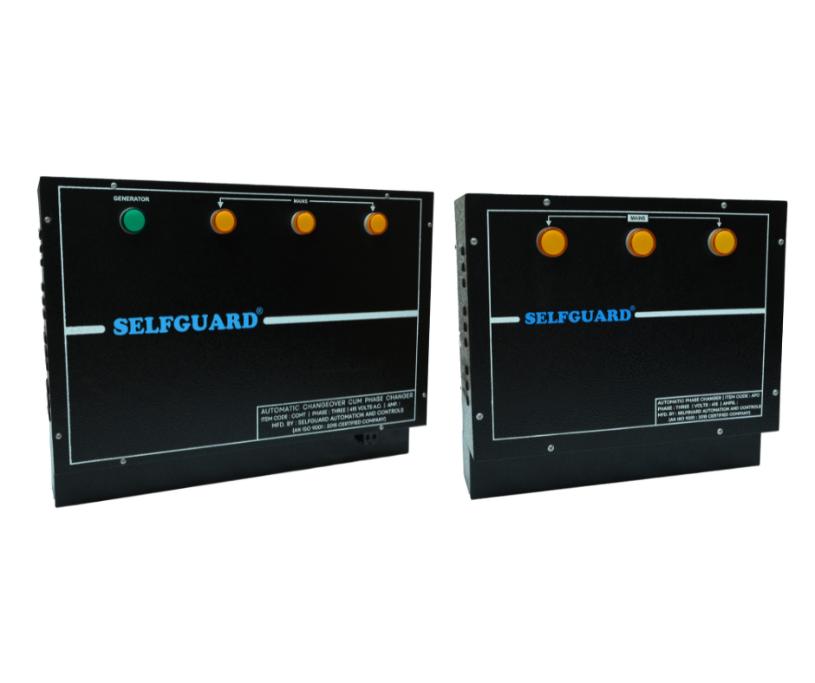
When the power supply is critical, the role of a Changeover Switch becomes fundamental. Whether in a home, workshop, or industrial facility, distinguishing between manual switching systems and automated ones is key. Below, we examine the common problems associated with manual changeover switches, followed by how an automatic changeover switch — as offered by Selfguard — resolves those issues.
Problems with Manual Changeover Switches
- Delay and interruption in power supply – When the mains fails, you must manually flick the switch or changeover lever, allowing the backup supply (usually a generator) to take over. That delay has the potential to stop equipment, disrupt ongoing processes, or cause damage. According to Selfguard, a changeover switch "allows a load to be transferred from one electrical source to another, either manually or automatically".
- Human error and unsafe intervention – Manual operation needs someone to act, often under pressure and possibly in a dark or hazardous situation. Mistakes might result in back-feed, faulty wiring, or dangerous switching.
- Mismatch in timing and load transfer – Manual switches may not transfer rapidly enough or may switch while loads remain high, resulting in voltage drops, equipment stress, or generator overload. Furthermore, the failure to effectively transition from generator to mains means that the backup may operate when not required or under improper load conditions.
- Poor transition management when mains returns – When mains power is restored, manual switches may cause uncomfortable repositioning, keeping the generator running at full load, squandering fuel, and lowering equipment longevity.
- Inadequate protection of sensitive equipment – Manual switching, particularly in settings containing electronics, HVAC, data systems, or industrial motors, may result in surges or brown-outs during the transition. Selfguard highlights that automatic solutions can assist in securing sensitive equipment.
- Complexity in three-phase systems – In industrial setups with three-phase supply, relying on manual changeover becomes even riskier. According to Selfguard’s blog, manual routines in such environments lead to a higher risk of downtime or error.
How Automatic Changeover Switches Solve the Problems
The automatic generator changeover switch from Selfguard offers solutions tailored to these issues:
- Instant detection and switching: The device monitors the primary supply and, if it fails, automatically transfers the load to the generator, returning when the mains is restored. Conforming to Selfguard: "When the mains power source is restored, this switch will switch the load back to the mains power supply."
- No manual intervention required: By eliminating the requirement for human intervention, you lower the likelihood of human error and harmful behaviours. The blog on generator difficulties states that automatic transfer switches avoid manual switching hazards.
- Seamless transition to backup and return: Selfguard's product descriptions feature units such as the single-phase model (CSNF) and three-phase model (CTF), which "transfer the load automatically from mains to generator and from generator to mains" and "shift the load … without any delay".
- Load-matched ratings & phase compatibility: An automatic switch, such as Selfguard's, guarantees that you select the proper rating for your load (e.g., 40 Amps to 200 Amps for single-phase; 63 Amps - 200 Amps for three-phase), preventing the switching component from becoming the weak link.
- Protection of equipment and reliability: The automation guarantees that the shift occurs reliably during peak loads or in critical equipment scenarios, minimising downtime and damage. This is emphasised in Selfguard's post on "How Auto Changeover Switches Ensure Smooth Operations During Peak Loads".
- Better generator usage: With automated switching, the generator is only activated when necessary and then switched back to mains operation (and placed on no-load) when the mains power returns, extending generator life and decreasing fuel waste. For example, the three-phase CTF model specifies that "After the Presence of Main Supply, this unit shifts the load from Generator to Mains without any delay, and Generator runs in No Load Condition.
Conclusion
In brief, when you use a manual changeover switch, you risk experiencing delays, human error, dangerous conditions, potential equipment damage, and insufficient backup synchronisation with your generator. Upgrading to a strong automatic generator changeover switch, such as those offered by Selfguard, provides smooth, rapid, and reliable switchover, protects vital equipment, maintains proper sizing and phase compatibility, and lowers generator wear and waste.
For any system where power continuity is critical—whether it is a home with a backup generator, a workshop, or an industrial facility—it is prudent to invest in an automatic switching solution rather than rely on human processes.